


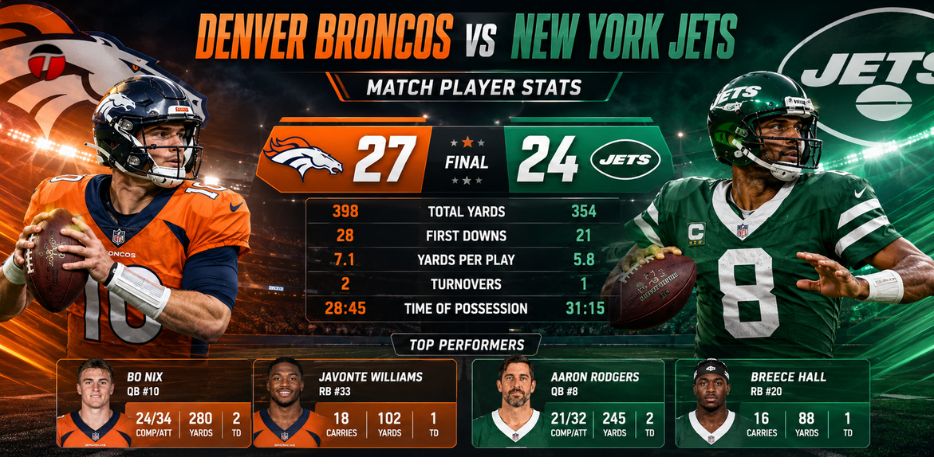
When two NFL teams travel across the Atlantic to play in front of a packed crowd at Tottenham Hotspur Stadium, you expect fireworks. What fans actually got when the Denver Broncos faced the New York Jets was something far stranger — a defensive slugfest where the final score read 13-11, yet the underlying player stats told an even wilder story than the scoreboard suggested.
If you searched for a Denver Broncos vs New York Jets player stats breakdown expecting a shootout full of gaudy passing numbers, you’re in for a surprise. This game turned into one of the most lopsided statistical performances of the season, even though the final margin was just two points. One team’s quarterback could barely move the ball, while the other’s skill players quietly stacked up just enough production to escape with a win. Numbers like negative net passing yards, a nine-sack outburst, and a kicker who somehow outscored an entire passing attack made this one of the more bizarre box scores of the year.
In this breakdown, we’ll walk through exactly what happened on both sides of the ball — who carried the offense, who dominated up front, and which numbers genuinely deserve the “you won’t believe this” label. Whether you’re a fantasy football manager reviewing box scores, a betting enthusiast looking for trends, or simply a fan trying to make sense of a confusing final score, this guide covers every meaningful stat from the game.
Quick Facts:
| Category | Denver Broncos | New York Jets |
|---|---|---|
| Final Score | 13 | 11 |
| Record After Game | 4-2 | 0-6 |
| Total Passing Yards | 174 | 45 (net: -10) |
| Total Rushing Yards | 78 | 92 |
| Sacks Allowed | 1 | 9 |
| Sacks Recorded (Defense) | 9 | 1 |
| Leading Passer | Bo Nix (19/30, 174 yds, 1 TD) | Justin Fields (9/17, 45 yds) |
| Leading Rusher | Breece Hall (22 car, 59 yds) | — |
| Leading Receiver | Evan Engram (5 rec, 42 yds) | Josh Reynolds (3 rec, 25 yds) |
| Game Location | Tottenham Hotspur Stadium, London | — |
This table alone hints at the story: Denver’s offense wasn’t explosive, but the Jets’ passing attack was historically bad, and Denver’s pass rush is the real reason the Broncos walked away with the win.
How the Game Unfolded Quarter by Quarter
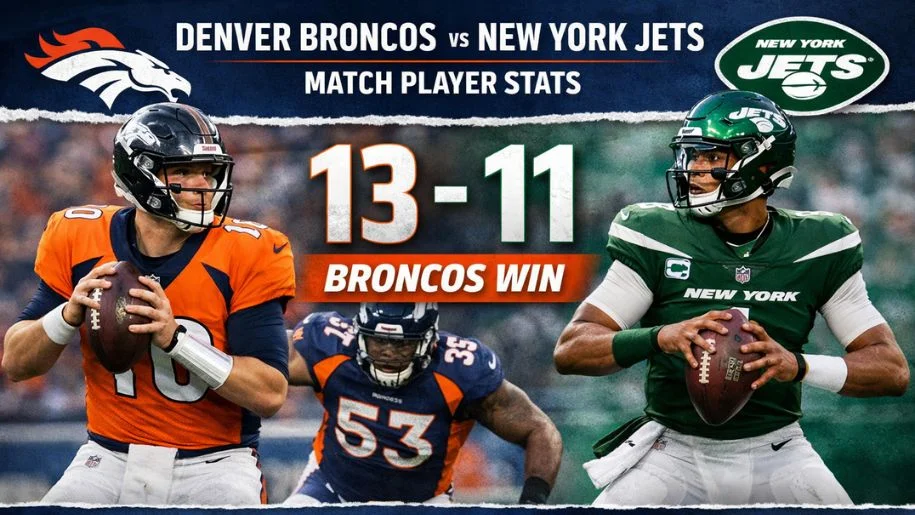
The Denver Broncos vs New York Jets Player Stats came out fast, scoring 10 points in the first quarter while the Jets answered with 6, setting an early tone that the game would be decided in short, ugly bursts rather than long, sustained drives. From there, the contest went cold. Both offenses combined for zero points in the second and third quarters except for a late Jets surge, with New York adding 5 points in the third quarter behind a safety and a field goal. Denver tacked on a single field goal in the fourth quarter to seal the 13-11 final.
What makes this scoring pattern so unusual is how disconnected it was from typical offensive flow. Most NFL games see points trickle in through long touchdown drives or two-minute-drill heroics. This game, by contrast, was defined by field position battles, special teams contributions, and defensive stops that turned into scores. The Jets actually outscored the Denver Broncos vs New York Jets Player Stats in the second half, 5-3, but their first-half hole was simply too deep to climb out of, especially with their passing game completely stalled.
It’s also worth noting how rare it is for a team to win an NFL game while being outgained on the ground and badly outgained through the air in raw passing yardage — except Denver’s yardage advantage came with a catch: New York’s offensive line allowed so many sacks that the Jets actually finished with negative net passing yardage once you factor in yards lost. That single data point explains more about this game than almost any other number in the box score.
Bo Nix’s Efficient but Unspectacular Day Under Center
Bo Nix didn’t put up eye-popping numbers, but in the context of this game, his stat line was more than enough. Nix completed 19 of his 30 passing attempts for 174 yards and a touchdown, finishing with a respectable 90.1 passer rating. He avoided turnovers entirely, throwing zero interceptions, which mattered enormously in a game decided by such a thin margin.
What stands out in Denver Broncos vs New York Jets Player Stats from the passing column is the modest 5.8 yards-per-attempt average. Nix wasn’t pushing the ball downfield aggressively; instead, he leaned on short, high-percentage throws to move the chains and protect a lead. This approach makes sense given the conditions: London games often come with unfamiliar field surfaces, travel fatigue, and a defense across the line that was clearly intent on making life difficult in the pocket. Nix was sacked just once, a remarkably low number compared to what his counterpart endured, and that protection gave him the freedom to play a clean, mistake-free game rather than force anything risky.
His lone passing touchdown went to tight end Nate Adkins, a moment that proved to be one of the most impactful plays of the entire contest given how few scoring opportunities either team generated. In a game this tight, a single accurate throw at the right moment carries outsized weight, and Nix delivered exactly when his team needed it.
Justin Fields and the Jets’ Historically Rough Passing Performance
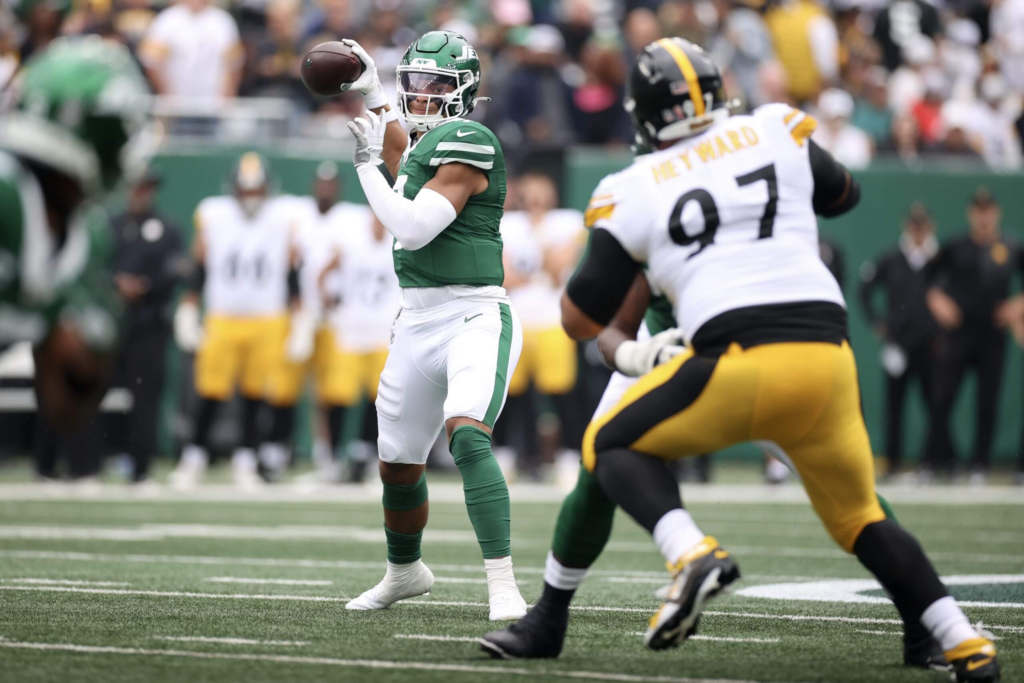
This is where the Broncos vs Jets player stats breakdown gets genuinely shocking. Justin Fields completed 9 of 17 passes for only 45 yards. On its own, that’s a quiet day. But factor in that the Jets’ offensive line allowed nine sacks for 55 yards lost, and New York actually finished the game with negative net passing yards — a statistical rarity that almost never happens in modern professional football.
A 2.6 yards-per-attempt average and a 58.7 passer rating paint the picture of a quarterback who simply never had a chance to operate. Nine sacks in a single game is an enormous number, the kind of figure that usually signals either a complete breakdown in pass protection, a defensive scheme that totally outclassed the blocking unit, or some combination of both. In this case, it appears to have been the latter, with Denver’s front seven consistently collapsing the pocket before Fields could find rhythm.
It’s important to separate the quarterback’s individual performance from the unit failure around him. Fields wasn’t asked to do much vertically, and when he did get clean looks, he distributed the ball reasonably well across his receiving corps. But no quarterback can overcome that level of pressure. Nine sacks is the type of number that shows up in historical “worst passing games” lists, and it single-handedly explains why the Jets’ offense never found any consistent footing despite a stronger showing on the ground.
Rushing Attack Comparison: Who Controlled the Ground Game?
Interestingly, the rushing battle actually favored New York, even in a losing effort. The Jets out-rushed the Denver Broncos vs New York Jets Player Stats as a team, gaining 92 yards on 31 carries compared to Denver’s 78 yards on 26 attempts. Breece Hall led all rushers in the game with 22 carries for 59 yards, a workhorse performance that kept New York’s offense from completely collapsing even as the passing game fell apart around him.
Denver’s ground game was more committee-based. J.K. Dobbins led the Broncos with 14 carries for 40 yards, while rookie RJ Harvey and quarterback Bo Nix himself contributed useful chunks on designed runs and scrambles. Nix’s 24 yards on five carries were particularly valuable, since quarterback mobility often becomes the difference-maker in low-scoring, field-position-driven games like this one. None of the rushers on either side found the end zone, reinforcing just how much this game was decided by inches rather than explosive plays.
What’s notable here is that rushing volume didn’t translate into winning. New York actually gained more total rushing yards, yet still lost the game by two points, which underscores just how damaging the sack total truly was. You can run the ball effectively and still lose if your quarterback is getting buried in his own backfield on what feels like every other passing down. This is a clear example of how one specific phase of the game — pass protection — can outweigh almost everything else on the stat sheet.
Receiving Stats: Tight Ends and Possession Receivers Take Center Stage
Neither team’s leading receiver was a traditional number-one wideout, which says a lot about how conservative both passing attacks were forced to be. For Denver, veteran tight end Evan Engram paced the team with 5 catches for 42 yards on 6 targets, operating as Nix’s primary safety valve over the middle of the field. Marvin Mims Jr. added a deep 30-yard, two-catch outing with a long of 26 yards, showing the kind of explosive element Denver’s offense occasionally flashed even in a generally low-volume passing day.
Nate Adkins, despite catching just 2 passes, made them count, hauling in the game’s only passing touchdown for 23 yards. That kind of efficient, high-value production from a depth tight end often goes unnoticed in a box score, but in a 13-11 game, those two catches were arguably the single most important receiving stat line of the entire matchup.
On the Jets’ side, veteran wideout Josh Reynolds led the way with 3 receptions for 25 yards, while Andrew Beck added 3 catches for 13 yards on a team-high 8 targets. Garrett Wilson, normally New York’s go-to weapon, was held relatively quiet given the circumstances, which speaks to how thoroughly Denver’s pass rush disrupted the timing routes that usually get him the ball. When a quarterback is under siege all game, even talented receivers struggle to get into rhythm, and that’s exactly what happened here.
Defensive Stat Leaders: The Real Story of the Game
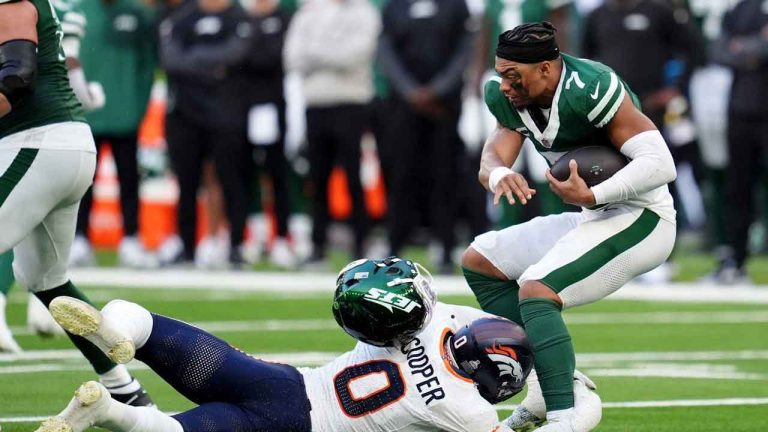
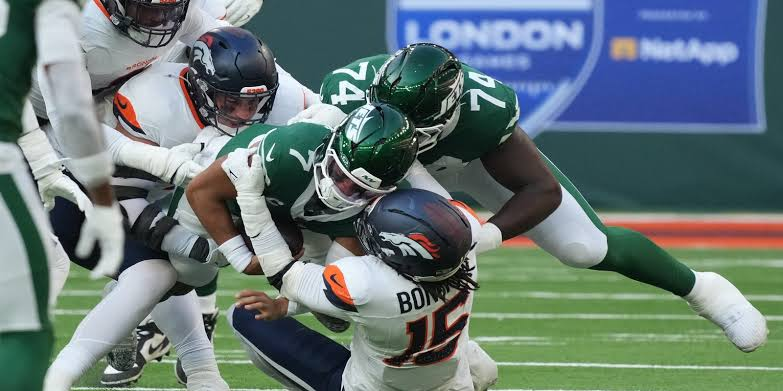
If you only look at one section of the Denver Broncos vs New York Jets player stats, make it this one, because the defensive numbers are what actually decided the outcome. Denver’s defense recorded a staggering 9 total sacks, an extraordinary number that reflects complete control of the line of scrimmage. Nik Bonitto and Jonathon Cooper each contributed multiple pressure-related disruptions, while Alex Singleton and Riley Moss led the team in total tackles with 7 apiece.
This wasn’t a single-player heroics story; it was a unit-wide performance. Denver’s front seven repeatedly collapsed pockets, forced quick, errant throws, and never allowed Fields to settle into any sort of comfortable rhythm. Nine sacks across a full team effort, rather than one or two standout pass rushers, suggests excellent scheme design from Denver’s defensive coaching staff combined with an overmatched Jets offensive line that simply couldn’t hold up over four quarters.
On the other side, New York’s defense actually played reasonably well too, finishing with 66 total tackles and limiting Denver to just one offensive touchdown. Jamien Sherwood led the Jets with 13 tackles, an impressive workload that shows he was constantly around the football. The Jets’ defense did its job by keeping the score within reach; it was the offensive line’s inability to protect Fields that ultimately sank New York’s chances, not a lack of defensive effort.
Special Teams and Hidden Stats That Mattered
In a game decided by two points, special teams numbers carry far more weight than usual, and this contest had a few that genuinely swung field position. Denver’s kicker Wil Lutz went a perfect 2-for-2 on field goals, including a long 57-yarder, while Jets kicker Nick Folk matched him by going 3-for-3, including a 52-yard make. Combined, the two kickers accounted for 16 of the game’s 24 total points, an enormous share for a position that rarely gets headline attention.
Punting numbers also reflected the field-position chess match underway. New York punter Austin McNamara averaged an impressive 50.7 yards per punt across seven attempts, consistently flipping the field in tight spots. Denver’s Jeremy Crawshaw matched the moment with a long punt of 62 yards. Return specialists Marvin Mims Jr. for Denver and Kene Nwangwu for New York both provided occasional spark, with Nwangwu’s 72-yard kick return long standing out as one of the single most explosive plays of the entire game.
These special teams numbers are easy to overlook in a typical Broncos vs Jets player stats breakdown, but in a game this close, they essentially functioned as a third unit deciding the outcome. When two offenses combine for fewer than 300 total net passing yards and one team finishes with negative net passing production, points from kickers and field position from punters and returners become disproportionately important.
What These Stats Mean for Both Teams Going Forward
For the Denver Broncos vs New York Jets Player Stats, this performance reinforced an identity built around defense and situational discipline rather than explosive offense. Denver’s nine-sack outburst is the kind of statement game that should give their coaching staff confidence heading into tougher offensive matchups later in the season. Bo Nix’s clean, turnover-free outing, even without huge yardage totals, shows a quarterback maturing into a manager role that complements a strong defensive identity rather than trying to do too much.
For the Jets, the numbers point to a far more concerning trend. Nine sacks allowed and negative net passing yards are not numbers a competitive offense can sustain, regardless of how well the running game or defense performs. If New York’s offensive line struggles continue at this rate, it will be difficult for any quarterback, regardless of arm talent or mobility, to generate consistent production. Expect this game to be a focal point of internal film study, particularly around pass protection schemes and personnel decisions up front.
Both teams will likely look back at this London matchup as a data point that shaped roster evaluations later in the year. Denver’s front seven proved it can dominate elite competition, while New York’s coaching staff faces tough questions about whether their issues are scheme-related or simply a personnel mismatch that needs to be addressed through trades or future roster moves.
Conclusion
At first glance, a 13-11 final score suggests a tightly contested, back-and-forth battle. But a closer look at the Denver Broncos vs New York Jets player stats reveals a far more dramatic story; one team’s pass rush completely dismantled the other’s passing attack, producing a rare negative net passing yardage performance that will likely be remembered long after the final score is forgotten. Bo Nix played efficient, mistake-free football, Evan Engram quietly led all receivers, and Denver’s defense turned in one of its most dominant statistical showings of the year with nine total sacks.
Meanwhile, Breece Hall and the Jets’ rushing attack did what they could, out-gaining Denver on the ground, but it wasn’t nearly enough to overcome the chaos in the passing game. For fans, fantasy managers, and analysts alike, this game serves as a reminder that final scores don’t always tell the full story — sometimes the real drama is buried in the stat sheet, waiting for someone to dig it up.
Must Read The Article: droven.io USA Tech Market Updates: How AI Is Changing America in 2026
(FAQs)
Who won the Denver Broncos vs New York Jets game?
The Denver Broncos won 13-11 in a game played at Tottenham Hotspur Stadium in London, improving to 4-2 on the season while the Jets fell to 0-6.
Who had the best passing stats in the Broncos vs Jets game?
Bo Nix led all quarterbacks, completing 19 of 30 passes for 174 yards and a touchdown without throwing an interception, finishing with a 90.1 passer rating.
Why did the Jets have negative passing yards
New York’s offensive line allowed nine sacks for 55 yards lost, which outweighed Justin Fields’ 45 gross passing yards and pushed the team into negative net passing yardage for the game.
Who led the Broncos and Jets in rushing yards?
Breece Hall led all rushers with 22 carries for 59 yards for the Jets, while J.K. Dobbins led Denver with 14 carries for 40 yards.
Which Broncos player scored the only passing touchdown?
Tight end Nate Adkins caught the lone passing touchdown of the game, a 23-yard reception from Bo Nix.
How many sacks did Denver’s defense record
Denver’s defense recorded nine total sacks against Justin Fields, a dominant performance led by contributions across the entire front seven, including Nik Bonitto and Jonathon Cooper.
Did special teams play a role in the final outcome?
Yes. Both kickers, Wil Lutz for Denver and Nick Folk for New York, went a combined 5-for-5 on field goals, accounting for 16 of the game’s 24 total points in a contest decided by just two points.
Related Topics: