


Introduction
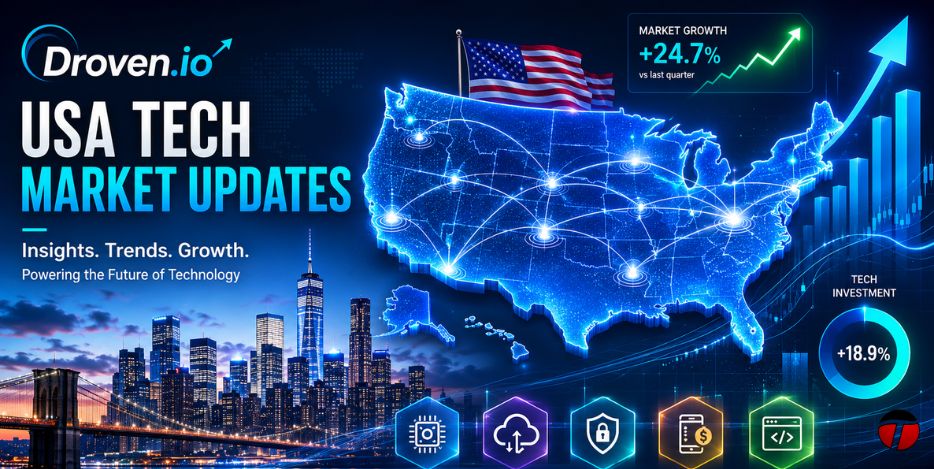
The United States technology sector has always been a bellwether for global innovation, but 2026 feels different. The pace of change has accelerated well beyond anything seen in previous tech cycles. Artificial intelligence is no longer a distant ambition or a research project locked away in university labs — it is embedded into business operations, healthcare systems, financial platforms, and everyday consumer tools. For anyone trying to make sense of this fast-moving environment, droven.io USA tech market updates have emerged as a trusted reference point for tracking the trends, investments, and disruptions defining the American tech economy.
What makes this moment particularly significant is that the transformation is not limited to Silicon Valley or a handful of Fortune 500 companies. From Main Street retailers adopting AI-driven inventory management to rural hospitals using machine learning diagnostics, the reach of technology in 2026 is broad, deep, and accelerating. Businesses of every size are wrestling with the same fundamental question: how do we adapt quickly enough to stay relevant? The insights offered through platforms like droven.io USA Tech Market Updates help businesses, investors, and professionals cut through the noise and focus on what actually matters.
This article offers a comprehensive look at the key forces shaping the American technology market in 2026. Whether you are an entrepreneur, a corporate strategist, a developer, or simply someone trying to understand the world changing around you, the following sections provide the context, data, and analysis you need.
Quick Facts:
| Metric | Value |
|---|---|
| U.S. AI market size (2025) | $173.56 billion |
| Projected U.S. AI market (2035) | $976.23 billion |
| U.S. share of global AI investment | 58% |
| Companies increasing AI budgets in 2026 | 58% |
| AI’s share of U.S. venture capital (2025) | 58% of all capital invested |
| Global AI infrastructure spending (2025) | $130+ billion |
| Countries developing AI legislation (2026) | 127 |
| Projected generative AI market by 2032 | $1.3 trillion |
The Rise of AI as America’s Core Economic Engine

For most of the past decade, AI was framed as a future technology — something that would matter eventually. In 2026, that framing is obsolete. Artificial intelligence has crossed from experimental to essential, and the numbers tell a striking story. The U.S. AI market was valued at $173.56 billion in 2025 and is on a trajectory toward nearly $1 trillion by 2035, growing at a compound annual rate of over 19%. This is not speculative growth fueled by hype. It reflects real adoption across real industries.
The most compelling sign of AI’s centrality to the American economy is where the money is flowing. In 2025, AI companies captured 58% of all venture capital invested in the United States, despite representing only 23% of total deals. In practical terms, that means one in every two investment dollars went into an AI-related company. This concentration of capital signals where experienced investors believe durable value will be created over the next decade. Platforms tracking droven.io USA tech market updates highlight this funding dynamic as one of the defining features of the current cycle — and it shows no sign of slowing down.
What is equally remarkable is the breadth of AI’s footprint. While much public attention focuses on large language models and consumer-facing chatbots, the deeper transformation is happening in enterprise software, logistics optimization, drug discovery, financial modeling, and energy management. These applications are less glamorous than headline-grabbing products, but they represent the kind of embedded, mission-critical adoption that tends to persist and scale.
Cloud Computing: The Infrastructure Backbone of Digital America
No discussion of U.S. tech market trends is complete without addressing cloud computing. Cloud infrastructure is not just a technology category — it is the foundational platform on which virtually every other modern technology depends. AI models require cloud-scale compute. Cybersecurity tools operate through cloud-based detection systems. Fintech platforms process transactions via cloud-native architectures. The entire digital economy, in other words, runs on cloud.
In 2026, enterprise cloud adoption has matured past the early adopter phase and become a baseline expectation. Most large organizations have already migrated their core systems to cloud environments. The current focus has shifted from migration to optimization — companies are now asking how to get maximum value from their cloud investments through better data architecture, cost management, and multi-cloud strategies. Hyperscalers like Microsoft Azure, Amazon Web Services, and Google Cloud continue to dominate, while specialized cloud providers are carving out positions in regulated industries like healthcare, finance, and defense.
The scale of cloud infrastructure investment is staggering. Morgan Stanley Research estimates nearly $3 trillion in global data center construction costs through 2028, with the United States accounting for the majority of that buildout. This infrastructure spending creates ripple effects across the broader economy — in construction, semiconductor demand, energy consumption, and skilled labor markets. For businesses monitoring droven.io USA tech market updates, cloud infrastructure investment is a leading indicator of where technology spending is headed across virtually every sector.
Cybersecurity: The Invisible War Shaping the Tech Market

As digital infrastructure expands, so does the attack surface available to malicious actors. Cybersecurity has evolved from a compliance checkbox into a strategic business imperative, and the market reflects that urgency. Enterprise security spending has surged in recent years as ransomware attacks, supply chain vulnerabilities, and nation-state threats have demonstrated how costly a lapse in digital defense can be.
In 2026, the cybersecurity landscape is defined by a fundamental tension: the same AI tools that organizations are using to improve productivity are also being weaponized by adversaries to conduct more sophisticated attacks. AI-powered phishing campaigns, automated vulnerability scanning, and deepfake-enabled social engineering have raised the stakes considerably. This has pushed security teams to adopt AI-driven defense tools of their own, creating what many analysts describe as an arms race between attackers and defenders.
The business opportunity in cybersecurity mirrors this urgency. Security-as-a-service platforms, zero-trust architecture solutions, and identity management tools are among the fastest-growing segments of the U.S. tech market. For investors and technology leaders following droven.io USA tech market updates, cybersecurity represents a sector where demand is structurally resilient — the need for protection does not diminish during economic slowdowns. If anything, tighter budgets tend to push organizations toward more cost-effective software-based security solutions, which benefits the software vendors in this space.
Generative AI: From Novelty to Necessity
If there is one technology subcategory that has fundamentally changed how people think about software, it is generative AI. What began as an impressive but niche capability — an AI that could write text or generate images — has evolved into a broad platform that is restructuring entire workflows across industries. In 2026, 51% of companies are using generative AI for content creation, customer support, and process automation, according to recent survey data.
The enterprise adoption of generative AI tools is particularly significant. Legal teams are using AI to draft and review contracts. Marketing departments are generating campaign materials at a fraction of the previous cost and time. Software engineers are using AI-assisted coding tools that dramatically accelerate development cycles. Finance teams are deploying AI models to automate reporting and scenario analysis. These are not marginal efficiency gains — in many cases, organizations are restructuring entire job functions around the capabilities these tools provide.
The generative AI market is projected to reach $1.3 trillion by 2032, which suggests that the current wave of adoption is still in its relatively early stages. The platforms and tools that dominate this market have not all been built yet. This creates significant opportunities for startups and established players alike, and it explains why so much venture capital continues to flow into this space. For anyone monitoring droven.io USA tech market updates, the generative AI segment is the single most important trend to watch over the next several years.
Fintech and the Digitization of American Finance
Financial technology has been reshaping American banking and consumer finance for years, but 2026 represents a period of particular acceleration. Traditional financial institutions are no longer simply tolerating fintech competitors — many are actively partnering with or acquiring them to accelerate their own digital transformation. At the same time, a new generation of fintech startups is addressing gaps in financial inclusion, business banking, payments, and investment services.
AI is deeply intertwined with fintech’s growth. Fraud detection systems powered by machine learning now flag suspicious transactions in milliseconds. Credit underwriting models are incorporating alternative data sources to extend credit to consumers who would have been excluded by traditional scoring methods. Robo-advisors are managing investment portfolios for millions of customers who lack access to traditional wealth management services. The combination of AI’s analytical power and fintech’s user-focused design is producing financial products that are faster, cheaper, and more accessible than anything available a decade ago.
The regulatory environment around fintech is also evolving rapidly. The Consumer Financial Protection Bureau and various state regulators are paying close attention to AI-driven credit decisions, data privacy practices, and the systemic risks posed by large-scale digital financial platforms. This regulatory attention creates compliance costs for companies, but it also signals that fintech has matured into a sector significant enough to demand serious oversight — which is ultimately a marker of legitimacy and staying power.
Semiconductor and Hardware: The Physical Foundation of the AI Economy
Software and algorithms get most of the headlines, but the AI revolution runs on hardware. Specifically, it runs on the specialized chips — GPUs, TPUs, and a growing family of custom silicon — that power the training and inference of large AI models. The semiconductor industry has become one of the most strategically important sectors in the American economy, and the U.S. government has taken extraordinary steps to maintain domestic leadership through the CHIPS Act and related policy initiatives.
The demand for AI-optimized hardware has created a supply crunch that continues to constrain deployment timelines for many organizations. The largest cloud providers have responded by developing their own custom chips to reduce dependence on external suppliers and optimize performance for their specific workloads. Meanwhile, a wave of chip design startups has emerged, each targeting specific AI application niches with purpose-built silicon. This innovation is gradually expanding the hardware ecosystem beyond a few dominant players.
For the broader technology market, semiconductor dynamics have important implications for cost, availability, and competitive positioning. Companies that can secure reliable access to advanced compute will have significant advantages in developing and deploying AI capabilities. Those that cannot may find themselves at a structural disadvantage regardless of how good their software is. This is why droven.io USA tech market updates increasingly dedicate significant attention to hardware trends alongside software and services developments.
Startup Ecosystem: Where the Next Generation of Tech Is Being Built

The American startup ecosystem remains the most vibrant in the world, even as the funding environment has become more selective following the exuberance of the early 2020s. In 2026, venture capital is flowing most heavily toward companies with clear AI integration, demonstrated product-market fit, and credible paths to profitability. The days of rewarding pure growth at the expense of all other considerations are largely over for most categories outside of AI infrastructure.
The geographic distribution of startup activity is also shifting. While Silicon Valley and New York remain dominant hubs, cities like Austin, Miami, Seattle, and Boston have developed robust droven.io USA Tech Market Updates ecosystems of their own. This diversification has been accelerated by the normalization of remote work, which allows startups to recruit talent from anywhere and operate without the overhead of expensive coastal real estate. The result is a broader, more geographically distributed innovation landscape than the U.S. tech market has ever seen.
Healthcare technology, climate droven.io USA Tech Market Updates , and enterprise software are among the most active startup categories in 2026. Investors are drawn to sectors where AI can deliver measurable outcomes — reducing diagnostic errors, optimizing energy grids, or automating complex business processes. The startups succeeding in this environment are not those chasing every trend, but those solving specific, high-value problems with genuine technical depth. This pattern of focused, application-specific innovation is one of the most important dynamics that droven.io USA tech market updates help readers understand and track.
Workforce and Skills: Navigating the AI Job Market
No discussion of the U.S. tech market transformation would be complete without addressing its impact on employment. AI’s rapid integration into business processes is reshaping the skills landscape in ways that affect workers across every industry and education level. The most in-demand professionals in 2026 are those who can bridge the gap between AI capabilities and business applications — people who understand both the technology and the domain where it is being applied.
The picture is more nuanced than either the optimists or pessimists typically describe. While AI is automating certain routine tasks, it is also creating demand for new roles in AI development, data management, model governance, and human-AI interaction design. Organizations are investing heavily in workforce training, with 37% of business leaders reporting plans to upskill their employees in AI-related competencies over the next few years. The workers best positioned for this environment are those who approach AI as a tool to amplify their existing expertise rather than a threat to resist.
The education and training ecosystem is adapting, though not always fast enough to meet demand. Universities are expanding AI and data science programs, bootcamps are proliferating, and major droven.io USA Tech Market Updates companies are investing in certification programs and apprenticeship models. For individuals navigating this environment, the practical guidance embedded in droven.io USA tech market updates — identifying which skills are in demand, which sectors are growing, and where opportunities are emerging — represents genuine career value beyond abstract trend analysis.
Future Outlook: What the Next Two Years Hold for American Tech

Looking ahead to 2027 and beyond, several themes are likely to define the continued evolution of the U.S. technology market. First, the AI productivity dividend will start showing up more clearly in economic data. We are still in the early phase of adoption, where the costs of implementation often precede the benefits. As AI tools mature and organizations develop better expertise in deploying them, the efficiency gains will become more visible and measurable.
Second, regulation will play an increasingly important role in shaping how AI is developed and deployed. With 127 countries either implementing or developing AI-specific legislation, the global regulatory landscape is fragmenting. U.S. companies operating internationally will need to navigate a patchwork of requirements around data privacy, algorithmic transparency, and AI safety. Domestically, the regulatory framework is still taking shape, but the direction of travel is clearly toward greater oversight of high-stakes AI applications.
Third, the hardware constraint will gradually ease as semiconductor capacity expands and AI chip design continues to improve. This will lower the cost of AI deployment and enable a new wave of applications that are currently uneconomical at today’s compute prices. The combination of cheaper compute, more capable models, and broader organizational expertise will create compounding benefits that are difficult to fully anticipate from our current vantage point. The trajectory, however, strongly suggests that what feels like a transformation today will look like a foundation layer in five years.
Conclusion
The American technology market in 2026 is a study in transformation at scale. Artificial intelligence, cloud computing, cybersecurity, fintech, and semiconductor innovation are not parallel trends — they are deeply interconnected forces that together are reshaping every major sector of the economy. The pace of change is unprecedented, the stakes are high, and the opportunities for those who are informed and prepared are genuinely significant.
Platforms like droven.io USA tech market updates serve a real and growing need: they help businesses, investors, professionals, and curious individuals make sense of a landscape that changes faster than traditional reporting cycles can capture. In an environment where the right insight at the right time can make the difference between capitalizing on a trend and being disrupted by it, staying informed is not optional — it is strategic.
Whether you are building a company, managing investments, developing your career, or simply trying to understand the world around you, the message from the U.S. tech market in 2026 is consistent: AI is not coming. It is here. The question is not whether to engage with it, but how to do so effectively.
Must Read The Article: The Untold Story of Isabella Revilla: Life Away from the Spotlight of Sheamus
(FAQs)
1. What are droven.io USA tech market updates?
Droven.io USA tech market updates refer to structured insights and analysis covering the key trends, technologies, and investment movements shaping the United States technology industry. These updates are useful for business owners, investors, developers, and professionals who want to stay informed about AI, cloud computing, cybersecurity, fintech, and startup activity without having to sift through complex technical reports.
2. Why is AI considered the dominant trend in the U.S. tech market in 2026?
AI has moved from experimental to essential across virtually every industry sector. The U.S. AI market reached $173.56 billion in 2025, the United States accounts for 58% of global AI investment, and 58% of companies plan to increase their AI budgets. This combination of massive investment, broad adoption, and accelerating capability development makes AI the defining technology trend of the current moment.
3. How is generative AI different from traditional AI, and why does it matter for businesses?
Traditional AI typically performs narrow, predefined tasks such as image classification or fraud detection. Generative AI can create original content — text, code, images, and more — based on natural language instructions. For businesses, this unlocks a wide range of productivity applications, from automated report writing and customer service to software development acceleration and marketing content generation.
4. What skills are most valuable for careers in the U.S. tech market right now?
The most in-demand skills in 2026 combine technical knowledge with domain expertise. AI integration, cloud architecture, cybersecurity, data analysis, and software engineering remain foundational. Beyond technical skills, the ability to understand business problems and apply AI tools to solve them effectively is increasingly valued. Professional development in these areas significantly improves career prospects across industries.
5. Is cybersecurity a good investment sector within the U.S. tech market
Cybersecurity demonstrates structurally resilient demand because threats do not diminish during economic downturns. As AI enables more sophisticated attacks, demand for AI-driven defense tools continues to grow. The sector attracts consistent investment and is considered one of the more durable growth areas within the broader technology market.
6. How does the U.S. semiconductor industry relate to AI growth?
AI models require specialized chips to train and run effectively. The semiconductor industry — including companies producing GPUs, custom AI chips, and data center hardware — forms the physical foundation of the AI economy. Government investment through programs like the CHIPS Act reflects how strategically important domestic chip production has become for U.S. economic and national security.
7. What should small businesses know about the current U.S. tech market trends?
Small businesses have more access to advanced technology than ever before, largely through cloud-based, subscription software that makes AI and automation tools affordable without large upfront investment. The key for small businesses is to identify specific, high-value processes where AI can save time or reduce costs, rather than adopting technology for its own sake. Following reliable sources like droven.io USA tech market updates helps small business owners make informed decisions without requiring deep technical expertise.
Related Topics:Must Read The Article: