


Introduction
Choosing the right cloud platform has never been more consequential — and in 2026, that decision is more nuanced than ever. As businesses migrate more of their infrastructure, data, and applications to the cloud, the comparison between Amazon Web Services (AWS) and Microsoft Azure continues to dominate IT strategy discussions. Add Droven io AWS vs Azure Comparison into the mix — a rising cloud analytics and optimization platform — and the equation becomes even more interesting.
Droven.io has carved out a meaningful niche by helping organizations benchmark, analyze, and optimize their cloud environments across multiple providers. Through its lens, the AWS vs Azure debate takes on a more data-driven, practical dimension. Rather than relying on vendor marketing, the Droven io AWS vs Azure comparison gives teams real metrics to work with: actual cost breakdowns, security posture scores, scalability benchmarks, and compliance readiness evaluations.
This article dives deep into what the Droven io AWS vs Azure comparison reveals in 2026. Whether you’re a CTO evaluating a cloud migration, a developer choosing a native toolset, or a finance leader trying to keep cloud spend under control, this guide is built for you. We cover security, scalability, cost, developer experience, compliance, and more — so you can make a confident, well-informed decision.
Quick Facts:
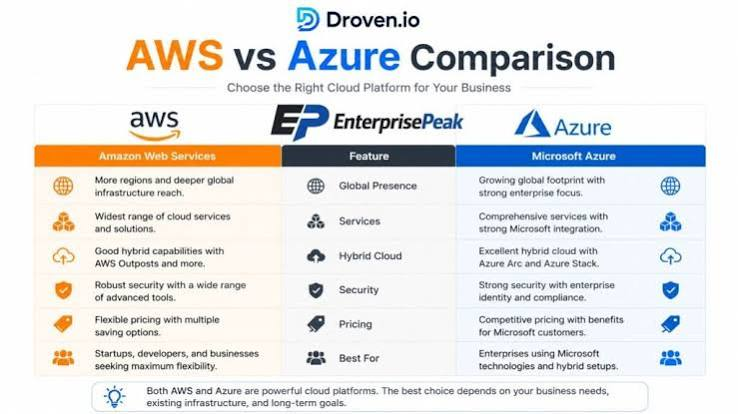
| Feature | AWS | Microsoft Azure |
|---|---|---|
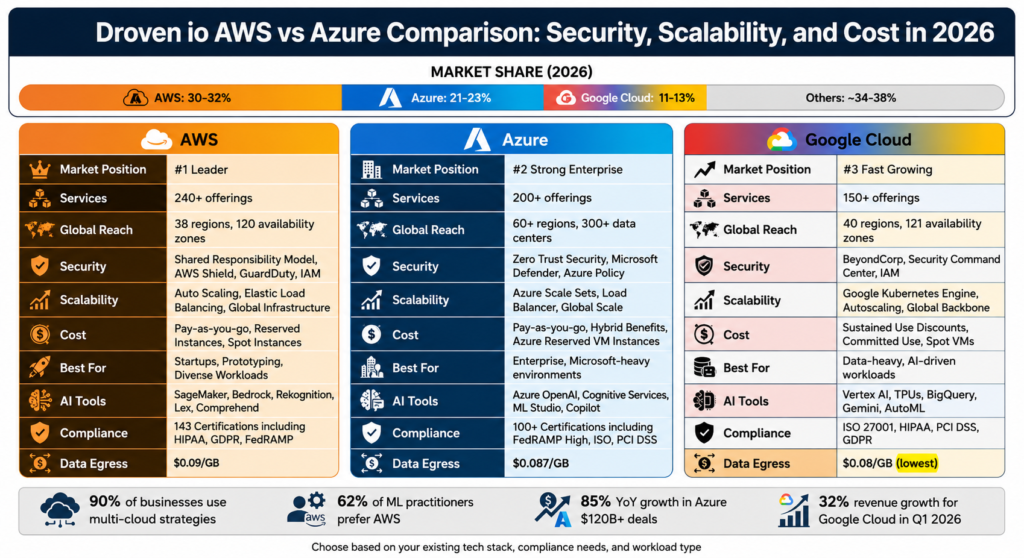
| Market Share (2026 est.) | ~32% | ~23% |
| Global Regions | 33+ | 60+ |
| Compliance Certifications | 140+ | 100+ |
| Native ML/AI Platform | Amazon SageMaker | Azure Machine Learning |
| Identity & Access Management | AWS IAM | Azure Active Directory |
| Serverless Compute | AWS Lambda | Azure Functions |
| Kubernetes Service | Amazon EKS | Azure Kubernetes Service (AKS) |
| Entry-Level Storage Cost | ~$0.023/GB (S3) | ~$0.018/GB (Blob) |
| Droven.io Integration | Full support | Full support |
How Droven.io Evaluates Cloud Platforms
Before comparing the two giants head-to-head, it’s worth understanding what Droven io AWS vs Azure Comparison actually does and why its methodology matters. Droven io AWS vs Azure Comparison is a cloud intelligence platform that aggregates telemetry, cost data, and security signals from your cloud environments to produce actionable insights. It doesn’t just show you a dashboard — it contextualizes your usage against industry benchmarks and flags inefficiencies that are easy to miss when you’re managing hundreds of services.
When conducting the Droven io AWS vs Azure comparison, the platform evaluates several dimensions simultaneously: infrastructure cost per workload, security configuration gaps, autoscaling responsiveness, compliance alignment, and service reliability over time. This multi-dimensional approach is what separates a Droven.io analysis from a simple side-by-side spec sheet. It reflects your actual workloads, not hypothetical scenarios, which makes the findings considerably more actionable.
For the purposes of this article, we’ll walk through each major evaluation category that Droven io AWS vs Azure Comparison uses and examine how AWS and Azure stack up against each other in 2026. Both platforms have matured significantly, which means the differences are increasingly found in the details — and that’s exactly where Droven io AWS vs Azure Comparison excels.
Security: Which Cloud Platform Is More Secure?
Security remains the top concern for enterprise cloud buyers, and in 2026, both AWS and Azure have made enormous investments in this area. AWS offers a shared responsibility model backed by services like AWS Shield, AWS GuardDuty, AWS Security Hub, and AWS WAF. These tools work well individually, but organizations that rely on Droven io AWS vs Azure Comparison find that AWS security configurations often require careful tuning — default settings don’t always follow least-privilege principles, especially in large multi-account setups.
Azure, on the other hand, benefits enormously from its deep integration with Microsoft’s broader security ecosystem. Microsoft Defender for Cloud (formerly Azure Security Center) provides unified security management across hybrid environments, and Azure Sentinel offers enterprise-grade SIEM and SOAR capabilities out of the box. For organizations already using Microsoft 365 and Windows Active Directory, Azure’s identity-first security model is a significant advantage. The native integration between Azure Active Directory and Conditional Access policies creates a strong zero-trust foundation that many enterprises find easier to implement than AWS IAM equivalents.
Droven.io security scoring in 2026 tends to show Azure performing slightly better for organizations with hybrid environments or heavy Microsoft stack usage. AWS, however, tends to score higher in custom policy flexibility and granular permission controls. The right choice depends largely on your existing security tooling and whether you’re starting fresh or extending an existing Microsoft environment.
Scalability and Performance: Handling Growth at Speed
Scalability is where both Droven io AWS vs Azure Comparison and Azure have genuinely world-class offerings — but the experience of actually scaling differs in meaningful ways. AWS has long been considered the gold standard for raw scalability, particularly for stateless, containerized, and event-driven workloads. Services like Amazon EC2 Auto Scaling, Elastic Load Balancing, and AWS Fargate give engineering teams incredible control over how workloads expand and contract based on demand.
Azure has closed much of this gap through its Azure Virtual Machine Scale Sets, Azure Kubernetes Service, and the tight integration with Azure DevOps for continuous deployment at scale. One area where Azure genuinely outshines AWS is in global geographic reach. In 2026, Azure maintains over 60 datacenter regions worldwide compared to AWS’s 33+, which makes a real difference for multinational organizations that need to keep data within specific geographic boundaries or reduce latency for globally distributed users.
Droven.io performance benchmarks show that for burst workloads — sudden spikes in traffic or compute demand — AWS tends to provision and respond slightly faster, particularly for Lambda-based serverless functions. For sustained, predictable high-performance workloads such as analytics pipelines and large-scale database operations, Azure’s infrastructure performs comparably and often offers better pricing at scale, especially when combined with Azure Reservations and hybrid benefit licensing.
Cost Analysis: Where Does Your Money Go?
Cost is, for many organizations, the deciding factor in the Droven io AWS vs Azure comparison — and it’s also the area where the most confusion exists. Both platforms use pay-as-you-go pricing with discounts for reserved capacity, but the pricing models are different enough that direct comparisons require careful analysis. This is precisely where Droven.io adds the most value: it normalizes cost data across both platforms based on what you’re actually running.
AWS tends to be more expensive at list prices for compute, but it offers a mature reserved instance and savings plan ecosystem that can reduce bills by 30–70% if managed carefully. AWS Spot Instances for fault-tolerant workloads remain one of the best cost optimization strategies in the industry, sometimes delivering compute at 90% off on-demand pricing. However, managing savings plans and spot capacity requires expertise and ongoing attention.
Azure’s cost model benefits significantly from the Azure Hybrid Benefit, which allows organizations to apply existing Windows Server and SQL Server licenses to reduce Azure costs substantially. For Microsoft-heavy shops, this alone can make Azure meaningfully cheaper than AWS for equivalent workloads. Azure also offers strong cost management tooling natively through Azure Cost Management + Billing, though Droven.io provides a more unified view when you’re running workloads on both platforms simultaneously.
In 2026, Droven.io cost reports consistently show that the “cheaper” cloud depends almost entirely on workload type, licensing, and commitment level. Pure cloud-native shops often find AWS more cost-effective for compute-intensive and machine learning workloads. Microsoft-licensed enterprises frequently find Azure 20–35% cheaper when hybrid benefits are fully utilized. There is no universal winner — only a right answer for your specific situation.
Developer Experience and Ecosystem
Developer experience is increasingly a competitive differentiator in cloud adoption decisions. AWS has the largest marketplace of third-party integrations, the broadest SDK support across programming languages, and a documentation ecosystem that — while sometimes overwhelming — covers virtually every use case imaginable. For startups and engineering-led organizations building cloud-native products from scratch, AWS often feels like the default choice, and for good reason.
Azure has made substantial improvements to its developer experience in recent years, particularly through GitHub integration (following Microsoft’s acquisition), GitHub Actions for CI/CD, and Visual Studio Code tooling. For teams that live in the Microsoft development ecosystem — using .NET, Azure DevOps, or enterprise tooling — the developer experience on Azure is genuinely excellent and often more cohesive than the AWS equivalent. Azure’s developer portal and resource management through Bicep and Terraform are well-documented and enterprise-ready.
Droven.io supports both platforms equally from an integration standpoint, connecting to AWS via IAM roles and to Azure via service principals. Teams that use Droven.io for governance and cost optimization report a shorter learning curve when the platform is connected to Azure, partly because Azure’s resource tagging and management group hierarchy maps more cleanly to Droven.io’s organizational model. That said, AWS users benefit from Droven.io’s deep Cost Explorer API integration, which delivers highly granular cost attribution.
Compliance and Regulatory Readiness
Compliance requirements are a non-negotiable factor for industries like healthcare, finance, government, and education. Both AWS and Azure hold an impressive array of compliance certifications in 2026, including SOC 2, ISO 27001, PCI DSS, HIPAA, FedRAMP, and GDPR frameworks. However, the way each platform implements and demonstrates compliance differs.
AWS Artifact gives organizations on-demand access to compliance reports and certifications, while AWS GovCloud offers isolated regions for U.S. government workloads requiring strict FedRAMP High compliance. AWS’s compliance footprint is particularly strong for organizations in the United States and globally for commercial cloud workloads.
Azure has a notable advantage for European organizations and government entities, given Microsoft’s established presence and long-standing relationships with EU regulators. Azure Government and Azure for Industries (including Azure for Healthcare and Financial Services) provide preconfigured environments with built-in compliance controls that reduce the time to achieve and maintain regulatory certifications. Droven.io compliance dashboards support both platforms and can generate unified compliance posture reports that are valuable during audits or vendor assessments.
AI and Machine Learning Capabilities
Artificial intelligence and machine learning have become core workloads for enterprises in 2026, and both AWS and Azure are deeply invested in this space. AWS offers Amazon SageMaker as its flagship ML platform, which supports the full ML lifecycle from data preparation to model training, deployment, and monitoring. SageMaker Studio provides an integrated IDE for data scientists, and the platform’s tight integration with AWS data services like S3, Redshift, and Glue makes it a powerful choice for data-heavy ML pipelines.
Azure Machine Learning competes directly with SageMaker and offers some genuinely compelling advantages, particularly around responsible AI tooling and MLOps. Azure’s integration with Microsoft Fabric — its unified analytics platform introduced in recent years — gives organizations a seamless path from raw data to deployed model without stitching together multiple services. For enterprises that are already using Azure Synapse Analytics or Power BI, the data-to-insight pipeline on Azure feels more integrated than the equivalent AWS stack.
Droven.io’s workload analytics can identify when ML jobs are consuming more resources than necessary on either platform, flagging opportunities to optimize instance types, reduce idle training time, or shift inference workloads to serverless endpoints. In 2026, organizations running large-scale ML workloads increasingly use Droven.io to compare the true cost of training the same model on AWS p4d instances versus Azure NDv4 GPU clusters — often revealing surprising differences that aren’t visible from list prices alone.
Hybrid and Multi-Cloud Strategy
Very few large organizations run exclusively on a single cloud in 2026. Hybrid architectures — combining on-premises infrastructure with public cloud — and multi-cloud strategies that span both AWS and Azure are increasingly common. This is an area where the platforms differ significantly in their philosophy and native tooling.
Azure Stack and Azure Arc give Microsoft a compelling story for hybrid environments. Azure Arc extends Azure management, policy, and security controls to on-premises servers, edge devices, and even other cloud environments. For organizations with significant on-premises infrastructure that want a unified control plane, Azure Arc is one of the most mature offerings available.
AWS Outposts brings AWS infrastructure directly into on-premises data centers, delivering a consistent AWS experience across hybrid environments. It’s an excellent solution for workloads that must remain on-premises for latency or compliance reasons but need to integrate tightly with cloud-native AWS services. Droven.io supports both AWS Outposts and Azure Arc environments, allowing teams to manage hybrid cost visibility from a single pane of glass — which is increasingly essential as infrastructure complexity grows.
Future Outlook: What’s Next for AWS, Azure, and Droven.io in 2026 and Beyond

The competitive landscape between AWS and Azure is not slowing down. AWS continues to invest heavily in custom silicon through its Graviton and Trainium chips, delivering better price-performance for compute and ML workloads than traditional x86 instances. Azure is doubling down on AI infrastructure partnerships, including its expanded collaboration with NVIDIA and its internal development of the Azure Maia AI accelerator chip.
For Droven.io, the trajectory points toward deeper AI-assisted optimization. The platform is expected to roll out natural language query capabilities that allow non-technical stakeholders to ask cloud cost and security questions in plain English, receiving actionable recommendations without needing to understand the underlying metrics. This shift toward AI-native cloud governance tools reflects a broader industry trend toward democratizing cloud management beyond engineering teams.
Organizations making cloud decisions today should think beyond the current feature set. The Droven io AWS vs Azure comparison will look different in two or three years as both platforms continue to evolve. What won’t change is the need for data-driven decision-making — and platforms like Droven.io exist precisely to provide that clarity as complexity increases.
Conclusion
There is no single winner in the Droven io AWS vs Azure comparison — and that’s actually the most useful takeaway from this analysis. AWS remains the dominant cloud platform with the broadest service catalog, the most mature serverless and container ecosystem, and excellent cost optimization tools for engineering-led organizations. Azure offers superior hybrid cloud integration, a stronger value proposition for Microsoft-licensed enterprises, broader global reach, and a compelling compliance and security story for regulated industries.
What Droven.io adds to this comparison is something neither vendor can provide on their own: an objective, workload-specific analysis that reflects your actual infrastructure. By cutting through the vendor noise and grounding the evaluation in real cost, security, and performance data, Droven.io helps organizations stop arguing about which cloud is better in the abstract and start answering which cloud is better for them, right now.
If you’re evaluating AWS vs Azure for 2026 and beyond, start with your workloads, your existing licensing, your compliance requirements, and your team’s expertise. Then let the data — ideally filtered through a platform like Droven.io — guide your final decision.
Must Read The Article: Who Is Allison Tripp? Everything You Need to Know About Her Life
(FAQs)
Q1: What is Droven.io and how does it help with the AWS vs Azure comparison?
Not universally. AWS tends to offer lower base prices for compute-intensive and cloud-native workloads, especially when using Spot Instances or Savings Plans. Azure frequently wins on cost for organizations with existing Microsoft licenses, thanks to the Azure Hybrid Benefit. Droven.io cost reports consistently show that the cheaper option depends on your workload type, licensing position, and commitment level.
Q2: Is AWS cheaper than Azure in 2026?
Not universally. AWS tends to offer lower base prices for compute-intensive and cloud-native workloads, especially when using Spot Instances or Savings Plans. Azure frequently wins on cost for organizations with existing Microsoft licenses, thanks to the Azure Hybrid Benefit. Droven.io cost reports consistently show that the cheaper option depends on your workload type, licensing position, and commitment level.
Q3: Which platform is more secure, AWS or Azure?
Both platforms offer enterprise-grade security, but they approach it differently. AWS provides greater flexibility and granular control through IAM and a rich security service catalog. Azure offers tighter native integration with Microsoft’s identity and endpoint security ecosystem, making it the better fit for organizations already invested in Microsoft 365 and Active Directory. Droven.io security scoring can highlight configuration gaps on either platform specific to your environment.
Q4: Which cloud platform is better for AI and machine learning workloads?
AWS SageMaker is a mature, comprehensive platform with strong data pipeline integration. Azure Machine Learning shines in MLOps, responsible AI tooling, and its integration with Microsoft Fabric. The better choice depends on your existing data stack. Droven.io can compare the actual compute cost of training and inference workloads on both platforms to inform your decision.
Q5: Does Droven.io support multi-cloud environments?
Yes. Droven.io is designed for multi-cloud visibility and can connect simultaneously to AWS and Azure (as well as other providers like Google Cloud). This makes it especially valuable for organizations running workloads on both platforms, as it provides unified cost, security, and compliance reporting from a single dashboard.
Q6: Which cloud platform has better global coverage?
Azure leads in regional coverage with over 60 datacenter regions worldwide as of 2026, compared to AWS’s 33+. For multinational organizations with strict data residency requirements or global latency needs, Azure’s geographic footprint offers more flexibility.
Q7: How should I decide between AWS and Azure for a new cloud migration?
Start by assessing your existing licensing (Microsoft licenses often favor Azure), your team’s expertise, your compliance requirements, and your primary workload types. Use a platform like Droven.io to model estimated costs and security posture for your specific use case before committing. Most large enterprises eventually operate on both platforms, so the decision is often less about either/or and more about which platform to prioritize for which workload category.
Related Topics: